Skip to content ↓

The progression of disciplinary skills

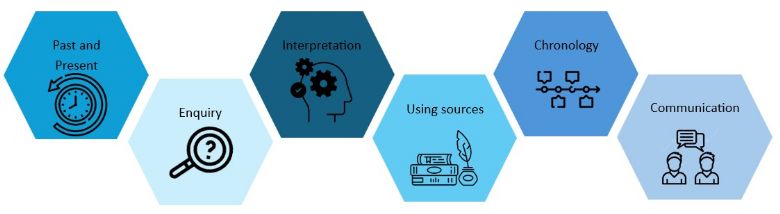
Medium-term plans define the substantive knowledge which should be learnt during the course of each unit. In addition, disciplinary skills are also defined; these are used, deliberately practised and developed in order for pupils to understand how historians work and how we learn about, and from, the past.

These disciplinary skills are broken down by phase and are integral to rich learning in history. As they are included in each unit, pupils will have 6 opportunities across their time in each phase to develop competency in their use before moving into the next stage of learning.
Past and Present

Nursery (3 and 4)

Reception

ELG

  • Begin to make sense of their own life story and family’s history
  • Show interest in different occupations


  • Talk about members of their immediate family and community
  • Name and describe people who are familiar to them
  • Comment on images of familiar situations in the past
  • Compare and contrast characters from stories, including figures from the past

Children at the expected level of development will:

  • Talk about the lives of the people around them and their roles in society
  • Know some similarities and differences between things in the past and now, drawing on their experiences and what has been read in class
  • Understand the past through settings, characters and events encountered in books read in class and storytelling

Communication – listening and attention

Nursery (3 and 4)

Reception

ELG

  • Enjoy listening to longer stories and can remember much of what happens
  • Understand ‘why’ questions, like: “Why do you think the caterpillar got so fat?”
  • Understand how to listen carefully and why listening is important
  • Learn new vocabulary
  • Listen to and talk about stories to build familiarity and understanding
  • Listen to and talk about selected non-fiction to develop a deep familiarity with new knowledge and vocabulary

Children at the expected level of development will:

  • Listen attentively and respond to what they hear with relevant questions, comments and actions when being read to and during whole class discussions and small group interactions
  • Make comments about what they have heard and ask questions to clarify their understanding
  • Hold conversation when engaged in back-and-forth exchanges with their teacher and peers

Communication – speaking

Nursery (3 and 4)

Reception

ELG

  • Use a wider range of vocabulary
  • Use longer sentences of four to six words.
  • Develop their communication but may continue to have problems with irregular tenses and plurals, such as ‘runned’ for ‘ran’, ‘swimmed’ for ‘swam’.
  • Be able to express a point of view and to debate when they disagree with an adult or a friend, using words as well as actions.
  • Start a conversation with an adult or a friend and continue it for many turns.
  • Use talk to organise themselves and their play: “Let’s go on a bus... you sit there... I’ll be the driver.”
  • Use new vocabulary through the day
  • Ask questions to find out more and to check they understand what has been said to them.
  • Articulate their ideas and thoughts in well-formed sentences
  • Connect one idea or action to another using a range of connectives
  • Describe events in some detail
  • Use talk to help work out problems and organise thinking and activities, and to explain how things work and why they might happen.
  • Engage in non-fiction books

Children at the expected level of development will:

  • Participate in small group, class and one-to-one discussions, offering their own ideas, using recently introduced vocabulary
  • Offer explanations for why things might happen, making use of recently introduced vocabulary from stories, non-fiction, rhymes and poems when appropriate.
  • Express their ideas and feelings about their experiences using full sentences, including use of past, present, and future tenses and making use of conjunctions, with modelling and support from their teacher.


Chronology

Year 1 and 2

Year 3 and 4

Year 5 and 6

  • Recognise the distinction between past and present
  • Place a few events or objects in order using common phrases to show the passing of time (old, new/young, days, months and years)
  • Recognise that their own lives are similar/different from the lives of people in the past
  • Identify some similarities and differences between ways of life at different times
  • Use common words and phrases relating to the passing of time such as before, after, yesterday, past, last year, a long time ago
  • Place events into different periods using the appropriate historical terminology e.g. decade, century, ancient, Roman, Egyptian, BC, AD, CE, BCE etc.
  • Identify where people and events fit into a chronological framework by noting connections, trends and contrasts over time
  • Recognise historical events as a coherent, chronological narrative from the earliest times to the present day
  • Explore main events, situations, changes and links within (and across) different periods e.g. differences/similarities between clothes, food, buildings or transport
  • Sequence events and periods using appropriate terms e.g. chronology, legacy, continuity, change, trends
  • Identify where people, places and periods fit into a chronological framework by analysing connections, changes, trends and contrasts over time
  • Establish clear chronological narratives across periods and within themes e.g. transport, beliefs, homes etc.
  • Describe and make links between main events, situations and changes within and across different periods of time, as well as between short- and long-term timescales

Communication

Year 1 and 2

Year 3 and 4

Year 5 and 6

  • Use a variety of historical terms such as invention, discovery, explorer, king/queen, history, long ago etc.
  • Use historical concepts such as now/then and same/different when making simple connections and noting contrasts
  • Describe special or significant events in their own lives
  • Demonstrate simple historical concepts and events through speaking, role-play, and picture stories
  • Retell simple stories about people and events from the past
  • Talk about who/what was significant/important in a simple historical account
  • Describe significant aspects of ancient history, local history, characteristics of societies, and achievements of mankind
  • Discuss some of the connections between local, regional, national and international history.
  • Talk and write about historical events and changes by selecting and organising historical information and dates
  • Discuss historical issues and changes
  • Use relevant and appropriate historical terms such as settlement, invasion, primary/secondary evidence, civilization, empire etc.
  • Communicate historical findings through a range of methods including the use of ICT, maps and timelines
  • Produce own accounts that make some connections and describe some contrasts
  • Describe and explain significant aspects of non-European societies as well as settlements in Britain
  • Discuss how Britain has influenced and been influenced by the wider world
  • Describe aspects of cultural, economic, military, political, religious and social history
  • Present answers to historical questions and hypotheses by selecting and organising relevant information using appropriate dates and terms
  • Discuss and debate historical issues acknowledging contrasting evidence and opinions.
  • Use appropriate vocabulary when discussing and describing historical events and concepts e.g. bias, reliability, democracy, parliament, peasantry and society
  • Choose the most appropriate way of communicating historical findings including the use of ICT, maps and timelines
  • Produce structured work that makes connections, provides contrasting evidence and analyses trends

Enquiry, Interpretation and Using Sources

Year 1 and 2

Year 3 and 4

Year 5 and 6

  • Make simple observations about different people, events, beliefs and communities
  • Ask and answer questions about the past through observing, handling and using a range of sources, such as objects, pictures, stories, plays, songs, film clips, buildings, museum displays and people talking about their past.
  • Consider why things may change over time.
  • Recognise some of the reasons why people in the past acted as they did. Ask questions e.g. what was different?’
  • Identify some of the basic ways the past can be represented, e.g. through pictures.
  • Choose parts of stories and other sources to show what they know about significant people and events.
  • Use sources to address historically valid questions and hypotheses about change, cause, similarity and difference, and significance. Ask questions e.g. ‘How did..?’ ‘Why were..?’ ‘What was important..?’
  • Recognise that our knowledge of the past is constructed from primary and secondary sources of evidence
  • Recognise how sources of evidence are used to make historical claims. Ask questions such as, ‘What might this tell us about..?’
  • Recognise that different versions of past events may exist
  • Recognise why some events happened and what happened as a result. Ask questions such as, ‘Why did..?’ ‘What were the effects..?’
  • Describe some of the different ways the past can be represented, e.g., through artists’ pictures, museum displays, films and written sources.
  • Identify historically significant people and events in different situations

  • Use a wide range of sources as a basis for research to answer questions and to test hypotheses.
  • Regularly address and sometimes devise historically valid questions about change and continuity, cause and consequence, similarity and difference, and significance. Ask questions such as, ‘How did life change..?’ ‘Why do we remember..?’ ‘Why do people disagree..?’
  • Recognise how our knowledge of the past is constructed from a range of different sources
  • Give some reasons for contrasting arguments and interpretations of the past. Ask, ‘Why have different stories been told about..?’
  • Describe the results of historical events, situations and changes, e.g., the impact on people’s lives.
  • Evaluate sources and make inferences
  • Choose relevant sources of evidence to support particular lines of enquiry
  • Recognise that some events, people and changes are judged as more historically significant than others